
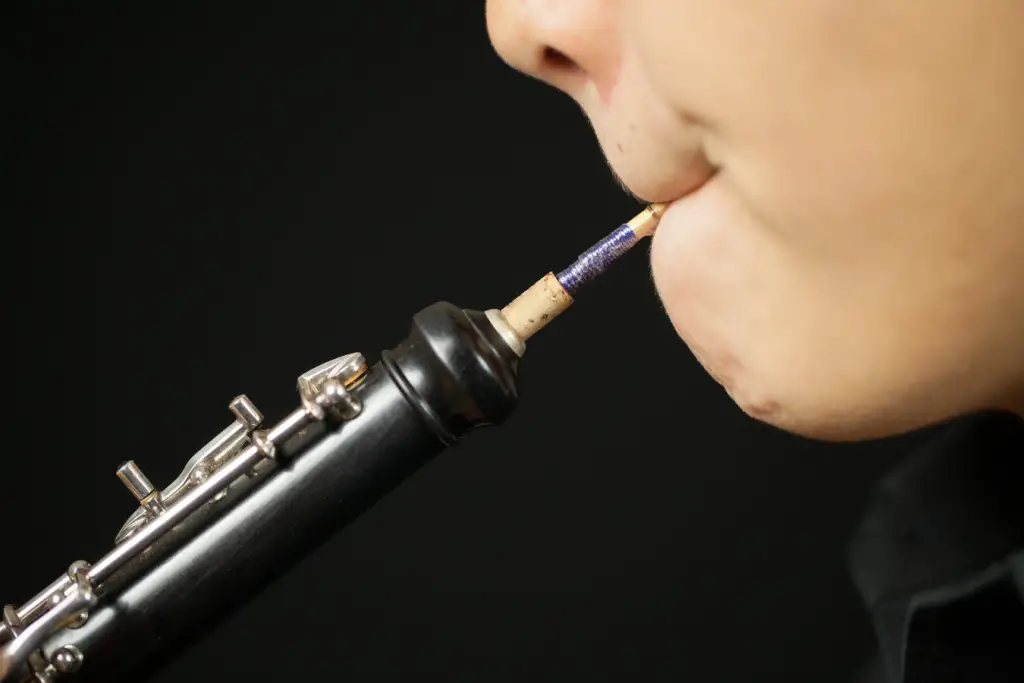
The oboe’s distinctive sound relies heavily on proper embouchure technique. This crucial element of playing involves the positioning of the lips, teeth, and facial muscles around the instrument’s reed. A correct oboe embouchure forms a rounded “ooooh” shape with the lips, creating a flat chin and allowing precise control over airflow and pitch.
Mastering the oboe embouchure requires practice and attention to detail. The corners of the mouth should be drawn forward, with the lips rolled inward to cushion the reed. This technique helps maintain consistent pressure on the reed while playing, enabling oboists to produce a clear, resonant tone across all registers.
Developing a proper embouchure is essential for breath control and sound production on the oboe. With the correct embouchure, players can navigate the instrument’s natural resistance and achieve greater control over dynamics and intonation. Regular practice and careful attention to embouchure formation lay the foundation for expressive and technically proficient oboe playing.
Fundamentals of Oboe Embouchure
The oboe embouchure forms the foundation for producing a rich, expressive sound. Proper lip placement and shape are critical for controlling pitch, dynamics, and tone quality across the instrument’s range.
Embouchure Basics
The oboe embouchure involves forming the lips into an “ooh” shape around the reed. Players should relax their jaw and let it open naturally while gently closing the lips. Avoiding tension in the jaw is crucial for a flexible embouchure.
Rounding the lips into a whistle-like position creates a flat chin. From this starting point, players roll their lips inward slightly until the corners are firm.
The embouchure must coordinate with breath support to allow the reed to vibrate freely. This coordination enables the player to produce a full tone throughout the oboe’s dynamic range.
Lip Placement and Shape
Correct lip placement on the oboe reed is essential for sound production and control. The lips should cover about 1/3 of the reed’s tip, with the lower lip slightly farther forward than the upper lip.
Maintaining a rounded shape is key. The lips form a gentle cushion around the reed, neither too tight nor too loose.
Players adjust lip pressure to control pitch and dynamics. More pressure generally raises pitch and decreases volume, while less pressure lowers pitch and increases volume.
The corners of the mouth should remain firm to prevent air leaks. This firmness helps maintain consistent tone quality across different registers.
Breath Control and Support
Proper breath control and support are essential for producing a beautiful tone on the oboe. These techniques allow for consistent airflow and precise control over dynamics and pitch.
Diaphragmatic Breathing
Diaphragmatic breathing forms the foundation of proper oboe playing. This technique involves expanding the lower abdomen and lower back when inhaling, rather than raising the shoulders or chest.
To practice diaphragmatic breathing:
- Lie on your back with one hand on your chest and the other on your stomach.
- Inhale slowly through your nose, feeling your stomach rise while your chest remains still.
- Exhale through your mouth, letting your stomach fall.
Proper breath support allows oboists to maintain consistent air pressure against the reed’s natural resistance. This creates a steady, focused tone across all registers.
Air Stream Management
Effective air stream management is crucial for controlling dynamics and pitch on the oboe. It involves regulating the speed and quantity of air passing through the reed.
For soft dynamics, use a slower air stream with less volume. For louder dynamics, increase both the speed and volume of air. Maintain consistent support from the diaphragm regardless of dynamic level.
To improve air stream control:
- Practice long tones, focusing on maintaining steady pitch and volume.
- Work on crescendos and diminuendos to develop fine control over air speed and quantity.
- Use a tuner to ensure pitch stability while altering air stream intensity.
Coordinating the embouchure with breath is essential for producing a rich, expressive sound throughout the oboe’s dynamic range. This coordination allows the reed to vibrate freely while maintaining control over pitch and tone quality.
Oboe Reed Adjustments
Proper reed adjustments are crucial for optimal oboe performance. Two key aspects of reed management involve selecting the right reed and positioning it correctly in the mouth.
Reed Selection
Choosing the right reed is essential for producing a beautiful oboe tone. Reed resistance can be tested by gently blowing through it with a neutral embouchure. Gradually increase air pressure until the reed speaks.
A good reed should have:
- Appropriate opening size
- Balanced thickness throughout
- Even scrape on both blades
- Correct overlap at the tip
Softer reeds are often preferred for beginners, while more experienced players may opt for medium to hard reeds. The reed’s crow pitch can indicate its quality – aim for a crow around C or C#.
Reed Positioning
Proper reed positioning in the mouth is critical for producing a clear, resonant sound. Place the reed gently on the lower lip, then draw the upper lip over it to form an airtight seal.
Key points for correct reed positioning:
- Cover about 1/3 of the reed with your lips
- Avoid taking too much reed into your mouth
- Ensure the tip of the reed is exposed
- Maintain a firm but relaxed embouchure
The lips should wrap around the reed, with the mouth forming an “O” shape. This positioning allows for optimal vibration and control over pitch and dynamics.
Articulation Techniques
Proper articulation techniques are essential for clear and expressive oboe playing. Mastering tongue positioning and attack and release methods allows oboists to produce distinct, well-defined notes across various musical styles.
Tongue Positioning
The tongue plays a crucial role in oboe articulation. Players should position the tip of the tongue against the reed, just behind its tip. This creates a seal that stops air flow and vibration.
For single tonguing, the tongue releases from the reed with a “tu” or “du” syllable. Double tonguing utilizes alternating “tu-ku” or “du-gu” syllables for rapid passages.
Soft low articulation requires using only the tip of the tongue to articulate. The embouchure should be round and rolled out, but not so much that the pitch becomes flat.
Attack and Release
The attack refers to the start of a note, while release is how it ends. A clean attack involves coordinating the tongue’s release from the reed with proper air support.
For a crisp attack:
- Place tongue on reed
- Build air pressure behind tongue
- Release tongue quickly while maintaining steady air flow
Releases should be precise, ending notes cleanly without abruptness. Control the air stream and embouchure tension to taper the sound naturally.
Clarity of articulation is crucial for expressive music-making. Oboists must coordinate breath, tongue, and embouchure to produce notes from silence and distinctly separate them when needed.
Posture and Ergonomics
Proper posture and ergonomics are crucial for oboe players to maintain comfort, prevent strain, and optimize performance. Correct instrument hold and physical alignment allow for efficient breathing and precise fingering technique.
Proper Instrument Hold
The oboe should be held at a 45-degree angle from the body. Support the instrument with the right thumb under the thumb rest, allowing the fingers to curve naturally over the keys. The left hand cradles the upper joint, with the thumb resting on the thumb rest.
Keep wrists straight and relaxed to avoid tension. Fingers should hover close to the keys, ready for quick and precise movements. Maintain a light grip to prevent cramping and allow for fluid finger motion.
Balance the oboe’s weight between both hands to reduce strain on any single point. This distribution helps maintain control and stability during long practice sessions or performances.
Physical Alignment
Start with a straight, upright posture whether sitting or standing. Keep shoulders relaxed and down, avoiding hunching or tension. Feet should be flat on the floor, about shoulder-width apart, to provide a stable base.
Align the head naturally with the spine, avoiding jutting the chin forward or tilting the head back. This position allows for optimal airflow and reduces neck strain. The elbows should be slightly away from the body, creating space for proper breath support.
Maintain a neutral lower back curve to support good posture and breathing. Engage the core muscles lightly to provide stability. Regular breaks and stretching exercises can help prevent fatigue and maintain proper alignment during extended playing sessions.
Advanced Embouchure Techniques
Mastering advanced embouchure techniques allows oboists to achieve greater control and expressiveness in their playing. These skills enhance the quality and versatility of the oboe’s sound.
Vibrato
Vibrato adds warmth and depth to the oboe’s tone. It is produced by subtle fluctuations in air pressure and embouchure tension. To develop vibrato, start with slow, exaggerated movements and gradually increase speed.
Practice controlling the vibrato’s amplitude and frequency. Begin with long tones, focusing on maintaining a steady airstream while gently pulsing the diaphragm. As control improves, incorporate vibrato into scales and melodies.
Experiment with different vibrato speeds to suit various musical styles. Baroque music typically uses less vibrato, while Romantic pieces often call for a fuller, more pronounced effect.
Dynamic Control
Effective dynamic control relies heavily on precise embouchure adjustments. For soft playing, maintain a firm embouchure while reducing air pressure. This requires excellent breath support to prevent pitch instability.
To play loudly, increase air pressure while slightly relaxing the embouchure. Be cautious not to overblow, which can result in a harsh tone. Practice smooth transitions between dynamics to develop embouchure flexibility.
Use crescendos and diminuendos to refine control. Start with long tones, gradually increasing or decreasing volume while maintaining pitch stability. Apply this technique to scales and etudes for practical application.
Experiment with different reed openings to find the optimal balance for your embouchure strength and dynamic range. A slightly more open reed may offer greater dynamic flexibility but requires more precise control.
Troubleshooting Common Issues
Proper oboe embouchure can be challenging to maintain consistently. Players often encounter issues with reeds and fluctuating tone quality that require adjustments and troubleshooting.
Reed Problems
Reed placement is crucial for optimal sound production. The reed should be inserted fully into the reed well to prevent air pockets. If response issues occur, check that the reed is seated correctly.
Old reeds can cause pitch problems. As reeds age, they tend to play sharp. Regular reed replacement helps maintain consistent intonation and tone quality.
Reed opening affects embouchure pressure. Players should find the “sweet spot” where the reed’s opening and crow pitch align with their average embouchure pressure. This balance allows for greater flexibility across registers and dynamics.
Tone Fluctuations
A rounded, firm embouchure is essential for stable pitch and accurate intonation. Lips should maintain a whistling shape, avoiding excessive tension.
Embouchure fatigue can lead to clamping down on the reed, closing its opening. To address this:
- Take regular breaks during practice sessions
- Review proper embouchure formation
- Focus on maintaining consistent lip pressure
Creating the correct vowel shape (“ooooh” as in “Pooh”) helps form an effective embouchure. This shape encourages forward lip corners and a slight top lip curl, promoting better tone control.
Maintenance and Care
Proper maintenance and care are crucial for maintaining optimal embouchure and instrument performance. Regular exercises and attentive reed care contribute significantly to an oboist’s long-term success and enjoyment.
Daily Embouchure Exercises
Oboe players should engage in daily embouchure exercises to strengthen and maintain proper form. Begin with lip and jaw flexibility exercises. Practice forming an “ooh” shape with the lips, then transition to an “ee” shape. Repeat this 10-15 times.
Next, perform circular breathing exercises. Use a straw to alternate blowing and sucking air without using hands. This helps develop the necessary muscle control for sustained playing.
Incorporate long-tone exercises on the oboe. Start with middle C and hold for 20-30 seconds, focusing on maintaining consistent tone and pitch. Gradually move to higher and lower notes, paying attention to embouchure adjustments.
Long-term Reed Care
Reed care is essential for maintaining consistent embouchure and tone quality. Store reeds in a protective case when not in use to prevent warping or damage. Rotate between multiple reeds to extend their lifespan and allow proper drying between uses.
Soak reeds in clean water for 1-2 minutes before playing. Avoid using saliva, as it can lead to premature reed deterioration. After playing, gently wipe reeds with a soft cloth to remove moisture.
Regularly inspect reeds for signs of wear or damage. Trim the tip as needed to maintain proper vibration. Consider learning basic reed-making skills to adjust reeds to personal preferences and playing style.
Preventative maintenance extends to the oboe itself. Clean the instrument after each use with a swab to remove moisture. Periodically check for loose screws or pads and address issues promptly to ensure optimal performance.
Performance Considerations
Proper embouchure technique is crucial for successful oboe performances. Adapting the embouchure to different performance settings ensures optimal sound production and musical expression.
Solo Performance Nuances
In solo performances, oboists must refine their embouchure control to achieve expressive dynamics and tonal colors. Relaxing the jaw allows for greater flexibility in shaping the sound. Subtle adjustments to lip pressure can enhance vibrato and articulation.
Oboists should practice maintaining a consistent embouchure across all registers. This enables smooth transitions between notes and ensures a uniform timbre throughout the instrument’s range.
Dynamic control is essential for solo work. Players must learn to adjust their embouchure and air support to produce a wide range of volumes without compromising tone quality or intonation.
Ensemble Blend and Balance
When playing in an ensemble, oboists must adapt their embouchure to blend with other instruments. This often requires a slightly different approach than solo playing.
Tone color adjustments are key to achieving good blend. Players may need to soften their embouchure slightly to match the timbre of surrounding instruments.
Intonation is critical in ensemble settings. Oboists must be prepared to make quick embouchure adjustments to stay in tune with the group. This may involve subtle changes in lip pressure or reed position.
Balance considerations often require oboists to play with more restraint. A well-controlled embouchure allows for playing softly while maintaining good tone and projection when needed.