
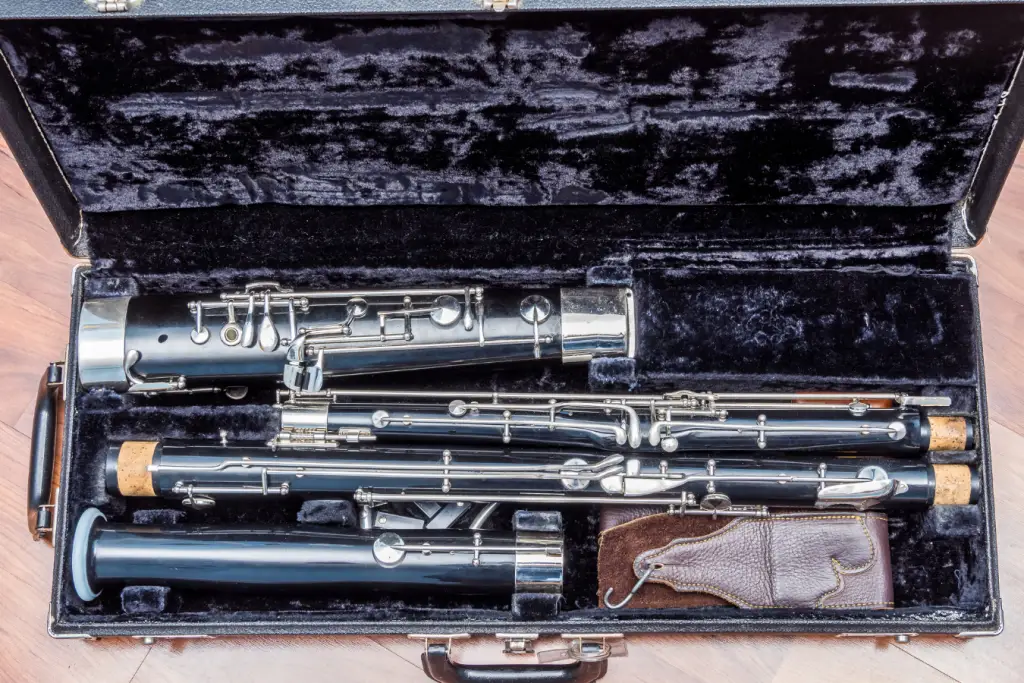
At first glance, the bassoon and the bass guitar may not seem like they have much in common. One is a woodwind instrument with a rich, reedy tone, while the other is a string instrument that provides the rhythmic and harmonic foundation in many genres of music.
But what exactly makes them different? And are there any surprising similarities?
In this article, we’ll explore:
✔ The fundamental differences in sound, structure, and playing techniques
✔ How they fit into different musical genres
✔ Which instrument might be right for you
Let’s break it down!
1. Instrument Type and Classification
The Bassoon: A Woodwind Instrument
The bassoon is a double-reed woodwind instrument that belongs to the woodwind family. It is primarily used in orchestras, wind ensembles, and chamber music.
✔ Uses a double reed to produce sound
✔ Air travels through a long wooden body with tone holes and metal keys
✔ Produces a warm, deep, and resonant sound
✔ Typically played seated with the instrument resting on the musician’s leg or supported by a neck strap
The Bass Guitar: A String Instrument
The bass guitar is a plucked string instrument that belongs to the guitar family. It is commonly found in rock, jazz, funk, and pop music.
✔ Uses four to six strings (most commonly four)
✔ Sound is produced by plucking or picking the strings
✔ Strings are tuned in fourths (E-A-D-G)
✔ Requires an amplifier to be heard clearly in most settings
2. Differences in Sound Production
How the Bassoon Produces Sound
✔ The double reed vibrates when the player blows air through it.
✔ The sound travels through the wooden tube and is shaped by finger placement on keys.
✔ Different notes are produced by opening and closing tone holes.
✔ Can play expressive, lyrical melodies or rich, low harmonies.
How the Bass Guitar Produces Sound
✔ The player plucks or picks the strings to create vibrations.
✔ The vibrations are amplified electronically using pickups and a speaker.
✔ Players can alter tone using effects pedals, finger techniques, or EQ settings.
✔ Often provides the rhythmic and harmonic foundation of a band.
3. Differences in Playing Technique
Bassoon Playing Techniques
✔ Breath control is crucial for tone quality and dynamics.
✔ Players use fingerings and key combinations to change pitch.
✔ Requires embouchure control (mouth position) to create a stable tone.
✔ Advanced techniques include vibrato, flutter tonguing, and multiphonics.
Bass Guitar Playing Techniques
✔ Players can use fingerstyle, pick playing, or slap bass techniques.
✔ Left-hand technique involves fretting notes on the fingerboard.
✔ Can incorporate slides, bends, and harmonics for stylistic effects.
✔ Often follows a steady rhythmic pattern to drive a song’s groove.
4. Role in Music and Ensembles
Bassoon’s Role in Music
✔ Found in orchestras, concert bands, and chamber music ensembles.
✔ Often plays bass lines, counter-melodies, or expressive solos.
✔ Used in classical music, film scores, and even some jazz settings.
Bass Guitar’s Role in Music
✔ Provides the rhythmic and harmonic foundation in most popular genres.
✔ Commonly used in rock, pop, jazz, funk, blues, and metal.
✔ Can take on a melodic role in jazz and solo bass performances.
5. Differences in Notation and Tuning
Bassoon Notation and Tuning
✔ Notated in bass and tenor clefs, with occasional use of the treble clef.
✔ Written at concert pitch, meaning what you see is what you hear.
✔ Has a wide range (typically from B♭1 to E5).
Bass Guitar Notation and Tuning
✔ Typically notated in bass clef.
✔ Standard tuning: E-A-D-G (one octave lower than a guitar).
✔ Often written in tablature (TAB), which shows finger placement on the fretboard.
6. Portability and Maintenance
Portability
✔ The bassoon is large, fragile, and requires a protective case.
✔ The bass guitar is bulkier but more durable, especially when using a gig bag or hard case.
Maintenance
✔ Bassoon: Requires reed care, regular cleaning, and periodic adjustments.
✔ Bass Guitar: Needs string changes, tuning, and occasional electronic maintenance.
7. Which Instrument Is Right for You?
If you’re trying to decide between the bassoon and bass guitar, consider the following:
Choose the Bassoon if You:
✔ Love orchestral or classical music
✔ Enjoy expressive, lyrical playing
✔ Are interested in challenging woodwind techniques
✔ Want to play in concert bands or chamber ensembles
Choose the Bass Guitar if You:
✔ Prefer modern, groove-based music
✔ Want to play in a band setting (rock, jazz, funk, pop, etc.)
✔ Like the idea of amplified sound and effects
✔ Want an instrument with more versatility across genres
Final Thoughts: Two Instruments, Two Worlds
While the bassoon and bass guitar serve very different purposes in music, both are fundamental in their own way.
✔ The bassoon provides a rich, resonant voice in classical music and wind ensembles.
✔ The bass guitar creates the groove and foundation in contemporary and popular music.
Whether you choose the bassoon for its warm, reedy expressiveness or the bass guitar for its driving, rhythmic power, both instruments offer unique musical experiences worth exploring.
Which one will you pick?