
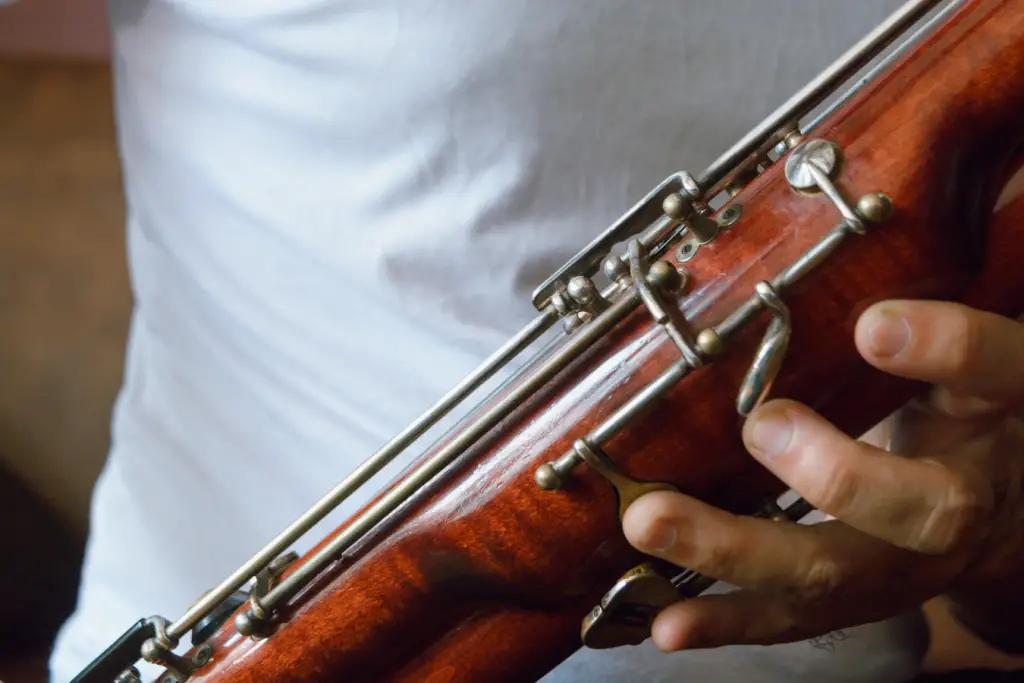
The chromatic scale is an essential exercise for all bassoonists. Mastering it improves finger agility, coordination, and intonation while helping players navigate difficult passages in music. Unlike diatonic scales, which follow a set pattern of whole and half steps, a chromatic scale consists of every note in succession, moving exclusively by half steps.
In this article, we’ll cover:
✔ What a chromatic scale is
✔ Why chromatic scales are important for bassoonists
✔ Step-by-step fingerings and techniques
✔ Common challenges and how to overcome them
✔ Effective exercises for mastering chromatic scales
1. Understanding the Chromatic Scale
The chromatic scale is made up of all twelve notes within an octave, moving in half-step increments. On the bassoon, this means navigating between standard fingerings, half-holes, and alternate keys.
✔ A one-octave chromatic scale contains 12 distinct pitches.
✔ A two-octave chromatic scale covers a wider range but follows the same stepwise motion.
✔ It can be played ascending (going up) or descending (going down).
In standard notation, a chromatic scale can be written using either:
- Sharps (♯) when ascending
- Flats (♭) when descending
However, in some cases, alternate enharmonic spellings are used to match practical fingerings on the bassoon.
2. Why Chromatic Scales Are Important for Bassoonists
Practicing chromatic scales offers numerous benefits, including:
🎵 Improving Finger Dexterity – Increases speed and coordination between hands.
🎼 Enhancing Note Transitions – Helps with smooth and even movement between notes.
🧠 Training the Brain – Develops muscle memory for complex passages.
🎶 Strengthening Embouchure Control – Helps maintain tone consistency across registers.
🎵 Preparing for Advanced Music – Many bassoon solos and orchestral excerpts contain chromatic runs.
3. Basics of Chromatic Fingerings on the Bassoon
Unlike diatonic scales, chromatic scales on the bassoon require the use of alternate fingerings for efficiency and smooth transitions.
A. The Role of Half-Holes and Flicking
✔ Half-holing – For notes like F# and G#, the player must slightly uncover the tone hole with the left-hand index finger.
✔ Flicking – For certain high notes, the player should lightly tap (“flick”) the octave key to prevent cracking.
B. Thumb Coordination on the Bassoon
✔ The left thumb operates multiple keys, making smooth transitions essential.
✔ In some registers, rolling the thumb is better than lifting it completely.
4. Step-by-Step Guide to Playing a Chromatic Scale
A. Starting in the Lower Register (Low Bb to Middle C)
The lower register requires precise air support and smooth finger transitions.
1️⃣ Begin on Low Bb (B-flat) – Thumb on the low Bb key, standard fingering.
2️⃣ Move up using chromatic fingerings: B, C, C#, D, D#, E, F, F#, G, G#, A, A#, B, C.
3️⃣ Use half-holes for F# and G# to avoid muffled notes.
✔ Keep fingers close to the keys to reduce unnecessary motion.
✔ Use a light touch on the keys—pressing too hard can slow transitions.
B. Mid-to-Upper Register (Middle C to High C or Higher)
The mid-range of the bassoon introduces more thumb coordination and flicking techniques.
1️⃣ From Middle C, progress chromatically through C#, D, D#, E, F, F#, G, G#, A, A#, B, C.
2️⃣ Flick the high D, Eb, and E keys to ensure smooth note transitions.
3️⃣ Keep the embouchure stable to maintain tone quality in higher notes.
✔ Watch for intonation issues—certain notes may require subtle embouchure adjustments.
✔ Use alternate fingerings where necessary for smoother transitions.
C. Playing Descending Chromatic Scales
Descending requires just as much control as ascending.
1️⃣ Start at the highest comfortable note and work downward.
2️⃣ Use the same flicking techniques in reverse for stability.
3️⃣ Maintain steady air pressure to avoid abrupt tone shifts.
5. Common Challenges and Solutions
A. Inconsistent Finger Transitions
✔ Problem: Fingers lifting too high between notes.
✔ Solution: Practice slow chromatic scales, keeping fingers close to the keys.
B. Uneven Air Support
✔ Problem: Sound dropping out in certain registers.
✔ Solution: Use steady, controlled air and maintain consistent support.
C. Difficulty with Half-Holes and Flicking
✔ Problem: Notes cracking or not responding.
✔ Solution: Practice half-hole drills and flicking exercises separately.
6. Effective Exercises for Mastering Chromatic Scales
A. Slow Practice with a Metronome
✔ Set a metronome to 60 BPM and play each note evenly.
✔ Gradually increase speed as comfort improves.
B. Rhythmic Variations
✔ Play chromatic scales using dotted rhythms (long-short, short-long).
✔ This helps improve finger agility and control.
C. Slurred vs. Articulated Practice
✔ Slur entire scales to focus on air control and smoothness.
✔ Articulate each note to work on tongue coordination.
D. Range Expansion
✔ Gradually extend chromatic scales into higher and lower registers.
✔ This builds fluency across the entire instrument.
7. Alternate Fingerings for Faster Chromatic Scales
Some alternate fingerings can make chromatic passages smoother and faster.
✔ Side Key for Bb – Instead of the thumb key, try using the side Bb key.
✔ Faster C# to D Transitions – Some fingerings allow for smoother transitions without using the standard break.
✔ Practice Different Fingerings – Experiment with alternate fingerings to find the most efficient movement.
8. Why Mastering Chromatic Scales Will Help Your Playing
🎼 Increases Finger Speed & Accuracy – Essential for fast passages.
🎵 Develops Breath Control – Helps with phrasing and endurance.
🎶 Improves Note Transitions – A must for smoother playing.
🎻 Essential for Orchestral & Solo Pieces – Many pieces have chromatic runs.
By practicing chromatic scales daily, you’ll see significant improvements in your overall bassoon technique.
Conclusion: The Key to Mastery
Learning to play chromatic scales on the bassoon requires dedication and proper technique. By focusing on finger coordination, air control, and alternate fingerings, bassoonists can master chromatic runs and apply them to advanced musical passages.
With consistent practice and smart exercises, you’ll develop speed, fluency, and accuracy—essential for any serious bassoonist!