
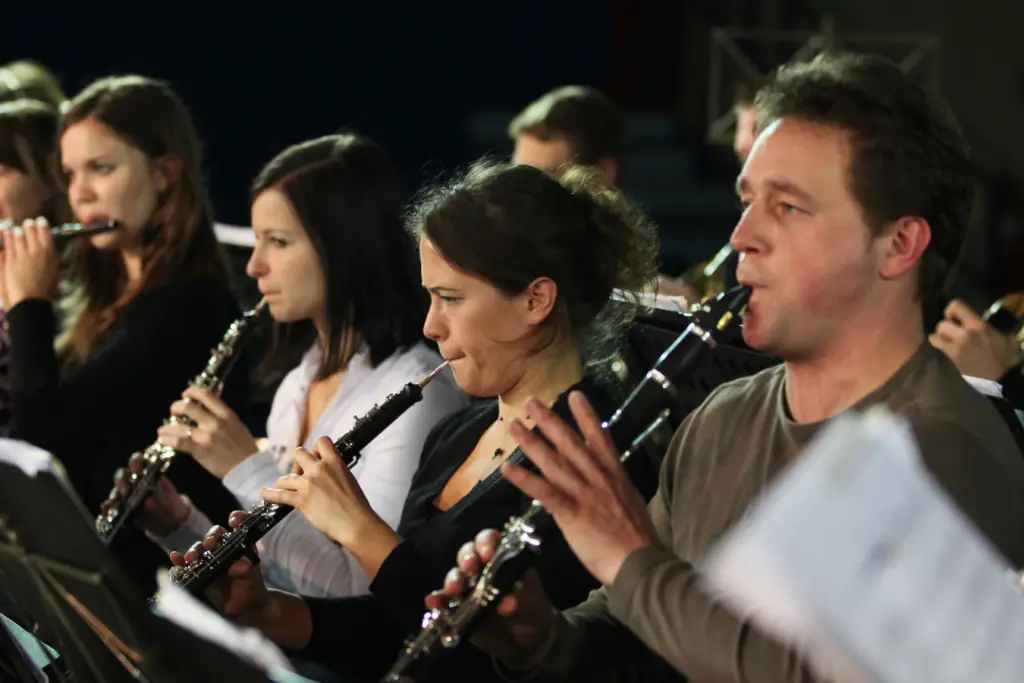
Warming up before playing the oboe is crucial for preparing both the instrument and the musician’s body. A proper warm-up routine helps oboists achieve optimal tone, intonation, and technical fluency during practice sessions and performances. A good warm-up routine for oboe typically includes long tones, scales, and articulation exercises to focus on breath control, embouchure strength, and finger dexterity.
Oboists should begin their warm-up with gentle exercises to ease into playing. Starting with long tones allows players to concentrate on producing a steady, resonant sound while gradually building embouchure strength. This can be followed by scale exercises, which help improve finger coordination and intonation across the instrument’s range.
Articulation exercises are another essential component of an oboe warm-up. These exercises help refine tongue placement and speed, enabling oboists to execute various articulation styles cleanly and precisely. By incorporating these elements into a consistent warm-up routine, oboists can set themselves up for more productive practice sessions and confident performances.
Understanding the Importance of a Warm-Up
Warming up before playing the oboe is crucial for optimal performance and long-term musical development. It prepares the body and mind for the demanding task of playing this complex woodwind instrument.
Physical Benefits
Warming up improves physical performance for oboe players. It increases blood flow to the muscles involved in playing, particularly in the fingers, hands, and embouchure. This enhanced circulation helps prevent strains and injuries during practice or performance.
For oboe players, a proper warm-up routine focuses on breath control and embouchure strength. Gentle long tones and scales help prepare the lips and facial muscles for extended playing periods.
Finger exercises gradually increase dexterity and speed, reducing the risk of cramping or fatigue during challenging passages. These physical preparations allow for smoother technique and greater endurance throughout practice sessions or performances.
Mental Preparation
A warm-up routine serves as a mental preparation for oboe playing. It helps musicians transition into a focused state of mind, leaving behind daily distractions.
During warm-up, players can assess their instrument’s condition, checking for any potential issues with reeds or key mechanisms. This proactive approach reduces anxiety about equipment malfunctions during performance.
Familiar warm-up exercises build confidence and set a positive tone for the practice session or performance ahead. They allow musicians to connect with their instrument and establish a sense of control over their playing.
Long-Term Development
Consistent warm-up practices contribute significantly to an oboist’s long-term development. Regular engagement with fundamental techniques reinforces proper playing habits and prevents the formation of detrimental ones.
Warm-ups provide an opportunity to refine intonation and tone quality gradually. Over time, this consistent focus on basics leads to noticeable improvements in overall sound production and musical expression.
Incorporating varied warm-up exercises challenges players to expand their skills continually. This approach fosters versatility and adaptability, essential qualities for professional oboists facing diverse repertoire demands.
Setting Up Your Practice Space
A well-organized practice space promotes focus and efficiency during oboe warm-ups. Proper setup ensures comfort and access to essential materials, allowing musicians to concentrate fully on their instrument.
Choosing a Comfortable Location
Select a quiet area with minimal distractions for oboe practice. Ensure adequate lighting to read sheet music and observe finger placement. A room with good acoustics helps in hearing tonal quality clearly.
Consider temperature and humidity. Oboes perform best in moderate conditions. Avoid practicing near air vents or in direct sunlight, as these can affect the instrument’s tuning.
Use a sturdy, straight-backed chair that allows for proper posture. Adjust the chair height so feet rest flat on the floor and arms are at a comfortable angle when holding the oboe.
Gathering Necessary Materials
Assemble all required items before beginning warm-ups:
- Oboe and reed case
- Music stand
- Metronome and tuner
- Water cup for soaking reeds
- Cleaning swab and cloth
- Pencil for marking sheet music
Keep spare reeds readily available. Store them properly to maintain their quality.
Place sheet music or warm-up exercises on the stand at eye level. Position the metronome and tuner where they’re easily visible without straining.
Arrange a small table or tray nearby for reed soaking and instrument assembly. This helps prevent accidental spills on sheet music or the instrument.
Breathing Exercises
Proper breathing techniques are essential for oboe players to produce a rich, controlled sound. These exercises focus on developing diaphragmatic breathing and breath control, two fundamental skills for oboe performance.
Diaphragmatic Breathing
Diaphragmatic breathing forms the foundation of effective oboe playing. To practice this technique, lie on your back with one hand on your chest and the other on your stomach. Breathe deeply, ensuring your stomach rises while your chest remains still.
Stand up and place your hands on your lower ribs. Inhale deeply, feeling your ribs expand outward. Exhale slowly, allowing your ribs to return to their original position. Repeat this exercise 5-10 times.
Try the 2+2 articulation exercise away from the instrument. This helps establish proper breathing patterns without the influence of holding the oboe.
Breath Control Techniques
Breath control is crucial for sustaining long phrases and maintaining consistent tone quality. Practice exhaling on a steady “hiss” sound, aiming to maintain a consistent volume for as long as possible.
Use a breathing bag or balloon to visualize your air capacity. Inhale deeply and exhale into the bag, noting how much you can fill it. Aim to increase this volume over time.
Incorporate long tones into your warm-up routine. Play a single note for 8-12 seconds, focusing on maintaining a steady air stream and consistent tone quality. Gradually increase the duration as your breath control improves.
Practice scales using different articulation patterns to develop control over your air stream while moving between notes.
Embouchure Strengthening
Strengthening the embouchure is crucial for oboe players to maintain control and endurance. Focused exercises can improve muscle flexibility and targeted strength.
Embouchure Flexibility
Oboe embouchure flexibility is essential for producing a consistent tone across all registers. Players should practice long tones, starting with middle register notes for 20-30 seconds each, followed by short breaks.
Expanding this exercise, oboists can attempt long tone scales or intervals, changing notes while sustaining for 30+ seconds. This helps develop control and stamina.
Another effective method involves playing leading tones from upper B to C, emphasizing the B. This challenges the embouchure, as the oboe naturally resists this transition.
Targeted Muscle Exercises
Specific exercises can help strengthen the muscles used in oboe playing. One technique involves creating an “ooooh” vowel shape with the mouth while keeping the lips gently closed. This action targets the muscles used in forming the embouchure.
Players should practice this shape without the instrument, focusing on relaxing the jaw and avoiding tension. Repeating this exercise for short durations throughout the day can significantly improve embouchure strength.
Embouchure endurance can also be enhanced by practicing with the reed alone. Players should aim to maintain a stable embouchure while producing a consistent crow for increasing durations.
Fingering Techniques
Proper fingering techniques are crucial for oboe players to produce clear, accurate notes and execute passages smoothly. Mastering hand positioning and practicing finger agility drills can significantly improve an oboist’s performance.
Hand Positioning
Correct hand positioning forms the foundation of effective oboe fingering. The left hand should be placed on the upper joint, with the thumb resting on the thumb rest. Fingers should curve naturally over the keys, maintaining a relaxed posture.
The right hand covers the lower joint, with the thumb supporting the instrument’s weight. Fingers should hover close to the keys, ready to press them without unnecessary tension.
Holding the oboe at a 45-degree angle away from the body allows for optimal finger placement and reduces strain during extended playing sessions.
Finger Agility Drills
Finger agility drills enhance dexterity and speed, enabling smooth transitions between notes. Daily practice of these exercises can lead to significant improvements in technique.
Scale exercises are essential for developing finger coordination. Start with simple scales and gradually increase complexity as skill improves.
Chromatic exercises help familiarize players with less common fingerings. Practice moving chromatically up and down the instrument’s range.
Trills and mordents strengthen finger independence. Begin slowly, focusing on clean articulation, then gradually increase speed.
Articulation exercises using various tonguing patterns (e.g., single, double, triple) in combination with finger movements can improve overall technique.
Articulation Practice
Articulation practice is crucial for oboe players to develop clarity and precision in their playing. It involves exercises to refine both single and double tonguing techniques.
Single Tonguing Exercises
Single tonguing is the foundation of oboe articulation. Start with simple exercises using scales or arpeggios. Play each note with a clear “tah” or “dah” syllable.
Begin slowly, focusing on evenness and consistency. Gradually increase the tempo as control improves. Use a metronome to maintain steady rhythm.
Practice articulating five D4s and C#4s softly in quick succession. Aim for clean attacks without squawking.
Try articulating five 16th notes on each scale degree, ascending and descending. Start at a comfortable tempo and work up to faster speeds.
Double Tonguing Drills
Double tonguing allows for faster articulation. It uses alternating “tah-kah” or “dah-gah” syllables.
Begin by practicing the syllables without the instrument. Once comfortable, apply them to long tones on the oboe.
Move on to scales, alternating between single and double tonguing. This helps develop control and evenness between the two techniques.
Use an easy scale like F Major or G Major for practice. Start slowly and gradually increase speed as proficiency improves.
Incorporate double tonguing into familiar passages or etudes. This helps integrate the technique into real musical contexts.
Tone Production and Control
Mastering tone production and control is essential for oboe players. These fundamental skills form the backbone of a rich, resonant sound and expressive playing.
Long Tones
Long tones are crucial for developing a beautiful, consistent oboe sound. Players should start with a single note, holding it for as long as possible while maintaining good tone quality.
Using a tuner helps ensure pitch accuracy. Focus on achieving a relaxed embouchure and steady airstream. Aim to produce a sound that emulates respected oboists.
Gradually expand the range of notes, working through different registers of the instrument. Pay attention to intonation and tonal consistency across all pitches.
Dynamic Range Exercises
Dynamic control allows for expressive playing and tonal variety. Begin with a comfortable middle-range note and practice crescendos and diminuendos.
Start at a moderate volume, gradually increasing to forte, then smoothly transitioning back to piano. Maintain pitch and tone quality throughout the exercise.
Advanced players can practice diminuendos from forte to pianissimo over 12 beats, focusing on steady pitch and controlled airflow. This develops the ability to play softly with good intonation.
Incorporate dynamics into scale practice, playing ascending scales with a crescendo and descending with a diminuendo. This combines pitch accuracy with volume control.
Intonation and Pitch Stability
Achieving proper intonation and pitch stability on the oboe requires dedicated practice and attention to technique. Skilled oboists use both electronic tuners and pitch bending exercises to refine their ability to play in tune consistently.
Tuner-Assisted Tuning
Electronic tuners are invaluable tools for oboe players seeking to improve their intonation. Regular practice with a tuner helps develop a more accurate ear and consistent pitch production. Players should start by tuning their A4 to the standard 440 Hz, then work through scales and arpeggios while watching the tuner.
It’s important to focus on maintaining steady pitch during long tones. This exercise develops breath control and embouchure stability. Oboists should also practice tuning intervals and chords with other instruments to improve ensemble playing skills.
Tuners can reveal pitch tendencies of specific notes on the oboe. Some notes may consistently run sharp or flat due to the instrument’s construction or the player’s technique. Identifying these trouble spots allows for targeted practice and adjustment.
Pitch Bending Techniques
Pitch bending is a crucial skill for oboists to master. It allows for fine-tuning intonation during performances and helps develop overall pitch control. One effective exercise involves arching the tongue to alter pitch without changing fingerings.
Players can practice bending pitches up and down in small increments:
- Start with a steady tone
- Gradually raise or lower the pitch without changing fingerings
- Return to the original pitch
This technique requires subtle adjustments to embouchure, air speed, and oral cavity shape. Regular practice improves pitch awareness and control.
Oboists should also work on pitch flexibility exercises, such as playing scales with deliberately exaggerated pitch fluctuations, then gradually reducing the range of movement. This builds the muscles and control needed for precise intonation in performance settings.
Playing Through Scales and Arpeggios
Scales and arpeggios form an essential part of warming up for oboe players. These exercises help improve finger dexterity, breath control, and tonal consistency across the instrument’s range.
Major and Minor Scales
Major and minor scales provide a foundation for technical proficiency on the oboe. Start with scales in easy registers, such as from half-hole D up to A or B-flat. Begin slowly, focusing on even tone and clean articulation.
Gradually increase the tempo as you warm up. Practice both ascending and descending scales. Pay attention to intonation, especially in the upper register.
Include natural, harmonic, and melodic minor scales in your routine. These develop familiarity with different key signatures and interval patterns.
Use varied articulations:
- All slurred
- All tongued
- Mixed patterns (e.g., slur two, tongue two)
Incorporate dynamics into scale practice. Play scales softly, then loudly, to improve breath control and embouchure flexibility.
Chromatic Scales
Chromatic scales enhance finger coordination and help oboists navigate challenging passages. Begin with a comfortable starting note, such as middle C.
Practice chromatic scales over one or two octaves initially. Extend the range as you warm up. Focus on smooth transitions between notes, especially across register breaks.
Use different rhythmic patterns to add variety:
- Eighth notes
- Triplets
- Sixteenth notes
Experiment with various articulation styles on chromatic scales. This improves tongue coordination with finger movements.
Pay special attention to tricky fingerings, such as the transition from F to F# in the middle register. Slow down and repeat these sections if necessary.
Incorporate chromatic arpeggios to challenge yourself further. These combine the benefits of both scale types in a single exercise.
Musicality and Expression
Warming up for musicality and expression prepares oboists to convey emotion and artistry through their playing. This phase focuses on developing control over phrasing, dynamics, and expressive techniques.
Phrasing and Dynamics
Warm-up routines should include exercises that enhance control over phrasing and dynamics. Practice long tones with varying dynamics, starting pianissimo and gradually increasing to fortissimo, then back to pianissimo. This develops breath control and embouchure flexibility.
Work on legato passages, connecting notes smoothly without breaks. Play scales or simple melodies, focusing on shaping each phrase with subtle dynamic changes.
Experiment with different articulations, such as staccato, tenuto, and marcato. This builds versatility in musical expression.
Expressive Techniques
Vibrato is a crucial expressive technique for oboists. Practice vibrato exercises during warm-ups, starting slow and gradually increasing speed. Use a metronome to maintain consistent pulses.
Work on pitch bending exercises to improve intonation and add expressive color to notes. Start with small intervals and gradually increase the range.
Practice trills and grace notes to enhance agility and ornamental playing. Begin slowly, focusing on clarity and evenness, then gradually increase speed.
Experiment with different tonal colors by adjusting embouchure and air support. This expands the palette of sounds available for expressive playing.
Cool Down after Practice
Properly ending an oboe practice session is crucial for both the player and the instrument. A cool-down routine helps relax the muscles and ensures proper care of the oboe.
Gentle Playing
Start the cool-down with some long tones at a soft dynamic level. This allows the embouchure muscles to gradually relax after intense playing. Focus on maintaining a steady, controlled airstream while slowly decreasing volume.
Play some simple, familiar melodies at a relaxed tempo. This helps transition the mind and body from practice mode to a more relaxed state.
Finish with some gentle scales or arpeggios, paying attention to smooth finger movements and even tone production. This reinforces good technique while allowing the body to wind down.
Instrument Care
Remove the reed and place it in a protective case. This prevents damage and helps maintain the reed’s shape and playing quality.
Swab the inside of the oboe thoroughly to remove moisture. Use a silk or microfiber swab, starting from the bell and working up to the top joint.
Disassemble the oboe carefully, wiping down each section with a soft, lint-free cloth. Pay special attention to the bridge key mechanism and other intricate parts.
Check for any loose screws or pads that may need attention. Address minor issues promptly to prevent more significant problems later.
Store the oboe in its case with proper support to maintain alignment. Keep the case in a temperature-controlled environment to protect the wood from warping or cracking.